CORTEX Architecture#
CORTEX federates identity and access across independent organizations so that researchers can sign in with their existing campus credentials and reach the applications a collaboration shares with them. A virtual organization (VO) is that collaboration: a group of people drawn from many home institutions who are granted a common set of resources.
Rather than ask every application to integrate with every campus, and every campus to trust every application, CORTEX places a single Federation Gateway between them. Each participant trusts only the gateway, and the gateway brokers identity, discovery, and authorization on their behalf.
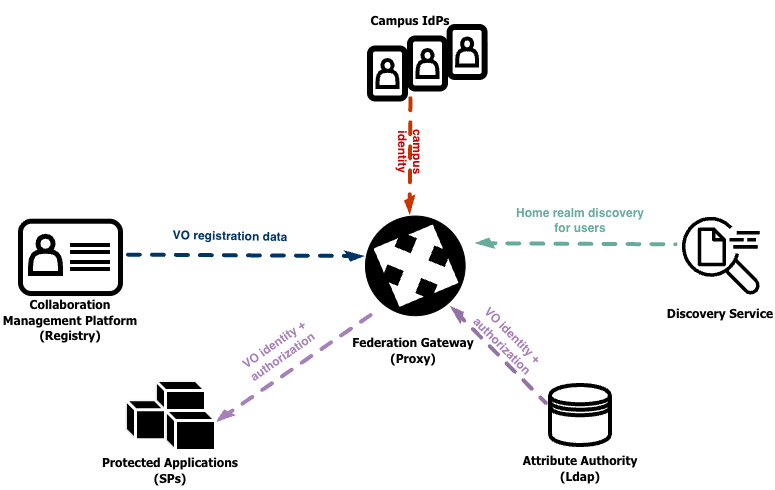
The sections below describe each component in the diagram above and the information it exchanges with the proxy.
Federation Gateway (Proxy)#
The Federation Gateway is the hub of the architecture. It presents itself as a service provider to campus identity providers and as an identity provider to protected applications, standing in the middle as a proxy. Every login flows through it.
This indirection is what keeps the collaboration manageable. Campuses and applications each maintain exactly one trust relationship — with the gateway — instead of one per counterparty. The gateway is also the single place where VO membership and entitlements are applied, so authorization decisions stay consistent no matter which campus a researcher comes from or which application they visit.
Campus Identity Providers#
Campus Identity Providers(IdPs) authenticate researchers against the credentials they already hold at their home institutions. When a user signs into an application integrated with CORTEX, their campus IdP asserts a campus identity to the proxy.
Guidance
CORTEX does not manage these credentials or replace campus login systems.
Discovery Service#
Because a Virtual Organisation (VO) spans many institutions, the proxy must first learn which campus a given user belongs to during the authentication process. The Discovery Service performs this home realm discovery role where a user selects their home institution to tell the proxy where to send the authentication request.
Collaboration Management Platform (Registry)#
Registry is the system of record for the virtual organization. It holds VO registration data of who has enrolled in the collaboration, the groups and roles they belong to, and the lifecycle state of their membership.
Registry answers the question of who belongs to the collaboration, which is distinct from who a person is at their campus. A researcher may be authenticated by their campus yet only be authorized once they appear as an active member in Registry. Membership managed in the Registry feeds the identity and authorization data the proxy ultimately releases to SPs.
Protected Applications (Service Providers)#
Protected applications are the resources the collaboration shares — the service providers that researchers ultimately want to reach. They delegate authentication and authorization entirely to the gateway.
An application never sees campus credentials and does not implement VO membership logic. It receives the VO identity and authorization attributes the gateway releases and enforces access using those attributes alone, which lets new applications join the collaboration without integrating with each campus individually.
How a login flows through CORTEX#
The components combine into a single sign-on path:
A researcher visits a protected application, which redirects the login to the Federation Gateway.
The Discovery Service helps the user pick their home institution, and the gateway forwards the request to the matching campus identity provider.
The campus IdP authenticates the user and returns a campus identity to the gateway.
The gateway resolves the user’s collaboration membership — enrolled in the Registry and served through the Attribute Authority — into VO identity and authorization attributes.
The gateway releases those attributes to the protected application, which grants access accordingly.
Guidance
Protected applications MUST delegate authentication and authorization to the Federation Gateway and MUST NOT trust campus identity providers directly.
Routing every login through the gateway is what preserves the proxy model’s guarantees. It keeps trust relationships one-to-one, ensures that VO membership and entitlements are applied uniformly, and prevents an application from acting on a campus assertion that has not been enriched with the collaboration’s authorization context.